Circular Economy – Your Questions Answered
In our new series of articles addressing fundamental topics central to the built environment, our team of experts will look to answer key questions our clients and readers may have. In this particular series we will be focussing on the subject of Circular Economy, looking at both how and why it can be applied to the construction industry. To begin with let’s start with an overview.
What is a Circular Economy?
Currently, and historically, the world’s economies can be defined as linear, meaning that raw resources are taken to manufacture a product which is used, sometimes only once, for its defined purpose then thrown away and the process starts again.

A Circular Economy on the other hand is based on a revolutionary model where waste is used as the raw resource to make the desired product which is then shared, repaired or reused for as long as is practically possible. When it cannot be used for its original purpose, the components, all of which are recyclable, are used as raw materials elsewhere.
By placing economic value on waste as a commodity it works to address the issue of our planet’s finite supply of raw materials.
A Circular Economy operates on the 3 main principles of Eliminate, Circulate and Regenerate all driven by a new approach to design that enables a product and its components to be kept within the economy for as long as possible.
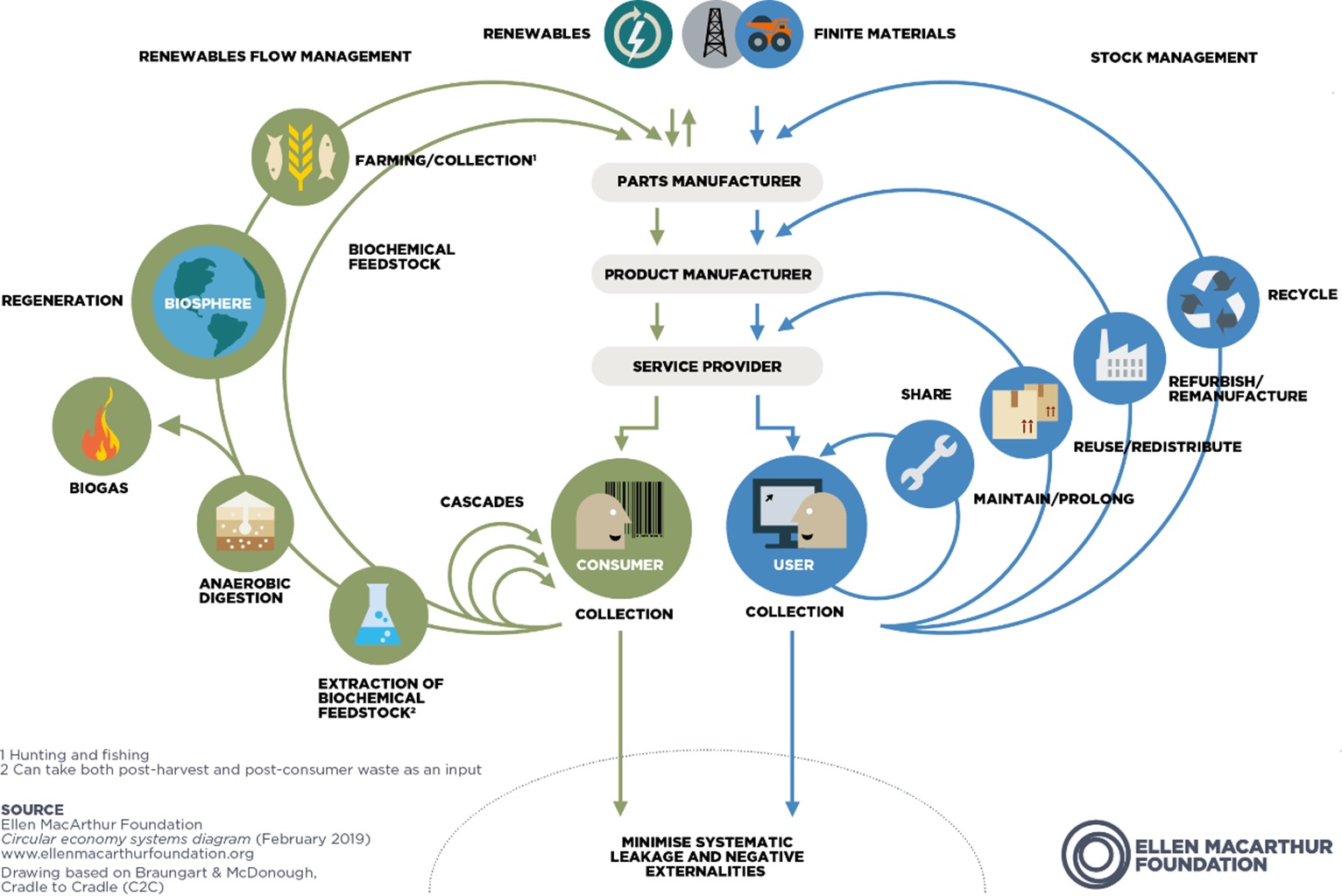
The Ellen MacArthur Foundation has been at the forefront in raising awareness and understanding on this subject. Their butterfly diagram below is a perfect tool for visualising how the circular economy can be applied to any sector.

To apply these principles more specifically to the construction industry, we can refer you to the UK Green Building Council’s proposed guidelines below that can be used in project briefs and procurement processes:
Reuse:
- Reuse the existing assets
- Recover materials and products on site or from another site
- Share materials or products for onward reuse
Design buildings for optimisation:
- Design for flexibility
- Design for longevity
- Design for adaptability
- Design for assembly, disassembly, and recoverability
Standardisation or Modularisation
Servitisation and leasing
Design and construct responsibly
- Use low impact materials
- Use recycled content or secondary material
- Design out waste
- Reduce construction impacts
Note: the fact there is not a sector-wide agreed set of principles is one of the obstacles that we address later in this series.
Why is a Circular Economy important in the fight against climate change?
Our current wasteful, albeit globally accepted economy, directly and negatively impacts our environment and cannot continue if we are to reduce carbon emissions to the extent necessary to avoid catastrophic changes to our climate.
Although progress has been made in relation to the built environment such as the decarbonisation of our energy supply, this is only a sticking plaster and in fact we should be addressing the issues right at the core of our industry and economy. If we can adapt both our approach and mind-set, emphasising longevity and flexibility of buildings, recognising the financial and carbon value of ‘waste’ and the worth of regenerative design, it will reduce the need for high-emissions manufacturing.
In our next article, we will look at the challenges of adopting a Circular Economy and how we can overcome them.
To learn more about how the ASSESS team at Focus can assist you in applying these guidelines to your project, please click here


