
Imperative for environmental transparency in construction sees rapid increase in demand for EPDs
An EPD is an Environmental Product Declaration, a tool for manufacturers or trade associations to assess and publicly state the environmental impacts of a product, family of products or average group of products. EPDs are also valuable business-to-business marketing tools in an industry where transparency surrounding environmental impacts is increasingly important.
At the centre of an EPD is what is known as a Life Cycle Assessment (LCA). LCA is a methodology for quantifying the full environmental impacts of a given product system over its life cycle. Most notably, this includes impact on climate change but also a large number of other indicators such as stored carbon, ozone layer depletion, water and resource use.
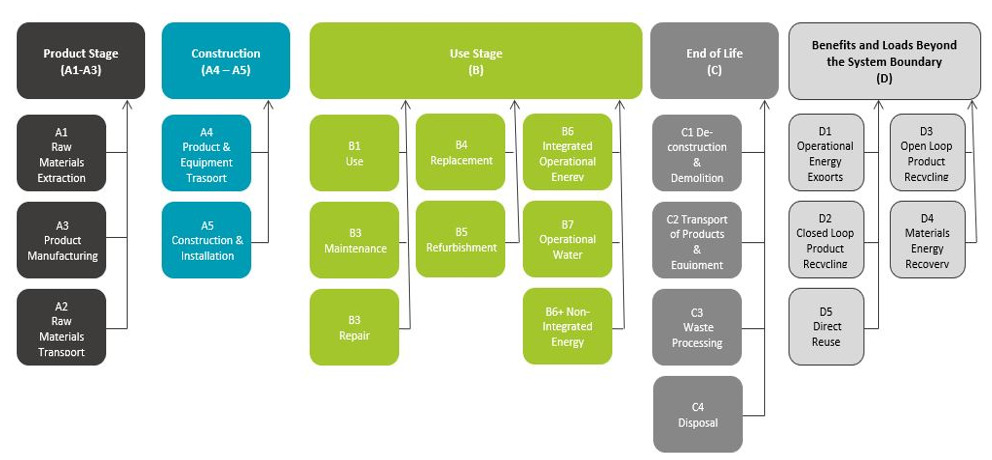
LCA methodology for EPDs is provided in EN 15804 which splits the life cycle stages of a product as below. An EPD will allocate impacts for all environmental indicators by life cycle stage.
What are the characteristics of an EPD?
The use of LCAs means that EPDs are objective, they show both the good and the bad when it comes to the environmental impacts of a product. This is one of the characteristics of a Type III Environmental Declaration according to ISO 14025. A second characteristic includes comparability; one EPD is comparable with another especially where the same background database has been used. This enables consumers to compare the environmental impacts of similar products to make informed choices.
Thirdly and most importantly, as a Type III Environmental Declaration, all EPDs must be verified by a third party to ensure the integrity of the document. Lastly, EPDs are highly accurate as they must be updated every five years to reflect any changes that may have occurred within the EPD owner’s supply chain or manufacturing processes.
These characteristics are what make EPDs robust and trusted documents in the construction industry. It also means that manufacturers holding EPDs for their products have strong grounds for the rebuttal of greenwashing accusations that may be made against them.
Why are EPDs important?
The information contained within an EPD makes them valuable tools primarily in the fight against climate change but also against other environmental concerns such as eutrophication and poor air quality. EPDs increase transparency surrounding a product’s environmental impact, thereby contributing to consumer knowledge and, as such, facilitate the purchase of products with lower environmental impacts versus alternatives on the market.
The growth in recognition of EPDs as a tool for manufacturers wishing to remain relevant in a data-driven industry, now unanimously understood as having significant environmental impacts, is exemplified by the rapid growth in the number of EPDs published. Over the past 10 years, the number of EPDs published to the standard used throughout Europe and other parts of the world has increased from under 1,000 to well over 12,000. In short, EPDs currently give a competitive edge but are likely in future to be seen as standard practice.
EPDs also promote manufacturer innovation creating benefits of increased transparency of the environmental impacts of their products, plus it encourages change to their manufacturing processes in order to remain competitive and maintain market share. Similarly, for manufacturers looking to sell their products in parts of western Europe such as France, EPDs are a legal requirement if the product is marketed with claims of good environmental performance.
What is the process of undertaking an EPD?
EPDs and the LCAs that inform them are relatively complex to undertake but the process and guidelines underpinning them are consistent. A declared unit will need to be chosen (e.g. 1 m2, 1 kg, 1 m3 or 1 unit of a product) and then one year’s worth of production data collected (e.g. energy and raw material consumption as well as total output). This data will then need to be taken pro-rata for the chosen declared unit. Once all parties are satisfied with the data inputs and any assumptions that needed to be made, the data is then inputted into a LCA and the EPD is generated. This is also the opportunity to ensure the EPD contains all relevant information about the product from a marketing perspective. The EPD and LCA report (if required) are then sent for third party verification ahead of formal publication.
How can Focus assist?
Focus have a track record of working closely with contractors, architects and product manufacturers alike to ensure buildings perform as they are designed. EPDs are an invaluable tool for accurately predicting the life cycle environmental impacts of a building and Focus are pleased to be able to offer this service to manufacturers. If you would like to learn more about EPDs then contact us on 0115 976 5050.


